Death among the Bulsa people of Northern Ghana is not merely an end of life but a deeply spiritual transition that binds the living, the dead, and the ancestors.
When a Bulsa person dies far away from their ancestral land, whether in another town, region, or country, the community performs a highly symbolic and sacred ritual known as the ngarika burial. This ritual ensures that the deceased is spiritually “returned home” and properly integrated into the ancestral world.
Death, Privacy, and Spiritual Risk in Bulsa Society
Among the Bulsa, death is treated as an intensely private affair. Ideally, a person dies in their native compound, surrounded by close family members, and is buried quietly, often on the same night.
Contact with a corpse is considered spiritually dangerous, especially for unauthorized persons, as the spirit of the dead is believed to be capable of luring the soul (chiik) of the living into the realm of the dead (kpilung).
Burial practices vary depending on age, status, and cause of death. A child, an elder, someone who dies naturally, or someone who dies violently or “in the bush” (outside the Bulsa homeland) all receive different ritual treatments. These distinctions reflect the Bulsa belief that death circumstances affect a person’s spiritual journey.
Why the Ngarika Burial Is Performed
The ngarika burial is performed when a Bulsa person dies outside Buluk and their body cannot be returned. Failure to perform this ritual is believed to bring misfortune, illness, and calamity upon the family.
Divination often reveals unresolved deaths as the cause of persistent hardship, compelling families to perform delayed rites, even for relatives they never met in person.
Recreating the Body: The Symbolism of the Mud Figure
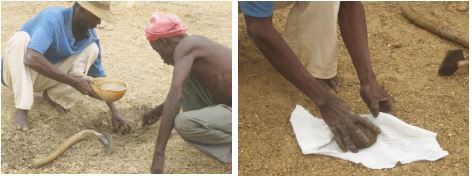
Central to the ngarika burial is the symbolic reconstruction of the deceased’s body. Since the actual corpse is absent, elders collect earth from a footpath leading toward the place of death and mould it into a human-shaped mud figure, wrapped in white cloth. From that moment, the figure is ritually treated as the deceased person’s body.
This symbolic body is buried with the same reverence, secrecy, and ritual detail as a real corpse, demonstrating the Bulsa belief that spiritual identity transcends physical remains.
Grave Digging and Sacred Night Rituals
The grave is dug near the entrance of the compound and carefully prepared through a series of rituals involving calabashes, stones, millet stalk torches, sacrifices of fowls and goats, and libations of millet water and local gin (akpeteshi). Each act is governed by ancestral law and tradition, reinforcing continuity between the living and the dead.
One of the most secretive rituals, kpiak-gebika, involves symbolically transferring all unresolved conflicts between the deceased and the living into a chicken, which is then sacrificed. The ritual is hidden from public view because witnessing it is believed to endanger the souls of the living.
The Burial and the Role of the Death Mat
After burial, attention shifts from the grave to the death mat (ta-pili), which becomes the main symbol of the deceased. Three days later, the mat is ritually hung inside the ancestors’ room (dalong).
From this point on, all condolences are directed toward the mat rather than the grave, highlighting the Bulsa belief that the dead remain present within the household.

Cleansing the Living: Smoking and Ritual Purification
Objects used during burial are ritually cleansed through smoke (nyiinika) to remove the smell of death (piisim). This purification allows the living to safely return to normal life without spiritual contamination. The conclusion of the rites is publicly announced using a traditional sound instrument known as da-goong, signaling that the deceased has been properly settled.
Tradition in a Changing World
Migration, Christianity, Islam, and modern hospital deaths have significantly reshaped Bulsa burial practices. While some families now perform Christian burials first, they still conduct ngarika rituals afterward to satisfy ancestral obligations. Even Bulsa migrants in Europe or North America often leave instructions for symbolic returns if their bodies cannot be transported home.
Despite modernization, the ngarika burial remains a powerful expression of identity, belonging, and spiritual responsibility. It reflects the Bulsa conviction that no one truly rests until they are reunited, symbolically or physically, with their ancestral land.
Conclusion
The ngarika burial is more than a funeral ritual; it is a cultural bridge between worlds. By recreating the absent body and observing every ancestral requirement, the Bulsa people affirm that death does not sever one’s ties to home, lineage, or tradition. In a rapidly globalizing world, the ngarika burial stands as a profound reminder that cultural roots continue to shape how communities understand life, death, and eternity.
Reference
Kröger, F. (n.d.). Returning home as a dead man: The Bulsa ngarika-burial. Buluk – Journal of Bulsa Culture and History.