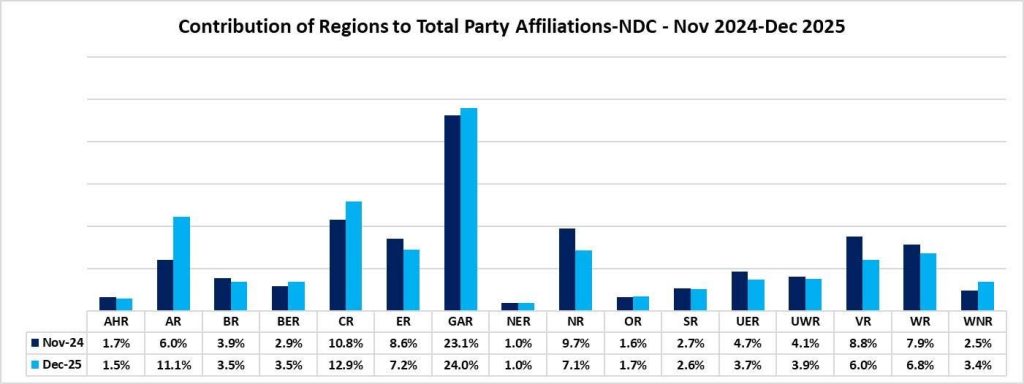
The National Democratic Congress (NDC) is witnessing a notable realignment in its voter base ahead of the 2025 elections, with fresh data highlighting the growing electoral significance of the Ashanti, Greater Accra, and Central regions. According to insights shared by political analyst Mussa K. Dankwa on his X (formerly Twitter) account, these three regions now collectively account for a commanding 48% of all NDC voters up from 40% in 2024.
Ashanti Region Emerges as a Key Battleground
Traditionally seen as a stronghold for the opposition, the Ashanti Region has seen a remarkable surge in NDC support. In 2024, the region accounted for just 6% of the party’s voter base. That figure has nearly doubled to 11% in 2025, signaling a potential shift in political dynamics and voter sentiment in the heart of Ghana.
Greater Accra Remains the NDC’s Powerhouse
Greater Accra continues to be the bedrock of the NDC’s national support. The region now contributes 24% of the party’s voter base, up slightly from 23% in 2024. This marginal increase reinforces its status as the single largest contributor to the NDC’s national footprint.
Central Region’s Steady Rise
The Central Region has also seen a notable uptick, growing from 11% in 2024 to 13% in 2025. This steady rise underscores the region’s increasing relevance in shaping the NDC’s electoral fortunes.
Declining Support in Traditional Bases
While the NDC gains ground in some regions, others are witnessing a decline. The Eastern Region’s share dropped by 1.3%, the Northern Region by 3%, Upper East Region by 1%, Volta Region by 3%, and Western Region by 1%. These declines suggest a redistribution of the party’s support base, possibly influenced by shifting demographics, campaign strategies, or regional issues.
What This Means for 2025 and Beyond
The data paints a picture of a party in transition. With nearly half of its support now concentrated in just three regions, the NDC may need to recalibrate its national strategy to consolidate gains and address emerging gaps. As the 2025 elections approach, these regional shifts could prove decisive in determining the party’s performance at the polls.