For the Bulsa people of northern Ghana, time is not counted in numbered months or calendar years but lived through nature, farming cycles, ancestral rites and communal festivals.
The Bulsa ritual calendar, deeply rooted in agriculture and spirituality, provides a structured system that guides social life, food production, and religious observance across Buluk.
Unlike the Western calendar, which measures time linearly, the Bulsa calendar is cyclical, revolving around the seasons, harvests, and ritual obligations. This indigenous system remains one of the most enduring cultural frameworks in northern Ghana, shaping daily activities and annual celebrations among the Bulsa people.
Time Without Numbers: The Bulsa Concept of Time
Traditionally, the Bulsa did not count years of life or record birth dates. Instead, time is expressed through events and natural markers. The Buli language contains a rich vocabulary for time references such as today (jinla), yesterday (diem), tomorrow (chum) and next year (bali), yet it historically lacked an abstract word for “time” itself.
Time is measured practically, by the movement of the sun, daily activities, and communal routines. Farmers indicate hours by pointing toward where the sun will be later in the day, while elders may mark meeting times by observing shadows cast by compound walls. This reflects a worldview where time is experienced, not calculated.
Market Cycles and Short-Term Timekeeping
In most Bulsa communities, markets occur every three days, while in places like Fumbisi, the cycle extends to six days. These market days help people estimate short-term periods such as travel or visits, although they hold little ritual importance.
The seven-day week is known, using Arabic-derived names, but it plays almost no role in ritual life. Many farmers do not rely on weekdays to organise activities, further highlighting the independence of the Bulsa calendar from global time systems.
The Moon and the Agricultural Sky
The lunar cycle plays a limited but symbolic role. The new moon is ritually important and considered taboo for certain activities such as sowing millet. Children born on the day of the new moon undergo special rituals to protect their health and strength, reinforcing the belief that celestial bodies influence human life.
The Bulsa also observe the Pleiades constellation, known locally as chiisa nuru. Its disappearance and reappearance in the sky signal key moments in the agricultural calendar, particularly the timing of early millet planting and flowering.
The Agricultural Year: The Core of the Bulsa Calendar
The Bulsa ritual calendar is anchored in the solar agricultural cycle, divided into the rainy season (yuei) and the dry season (wen-karik). The year ends and begins with the great harvest sacrifices (fanoai or feok bogluta), usually held between late November and December.
Each farming stage is marked by specific sacrifices:
- Seed sacrifices (zabuura-nyiam-bogta) before planting
- First-fruit sacrifices (naara-bogta) before eating new millet
- New millet sacrifices (za-paala-bogta) after early harvest
- Shea butter and oil sacrifices before consumption
- Ash rituals to protect crops from spiritual harm
- Final harvest festivals (feok / fanoai) marking thanksgiving and communal celebration
Until these rituals are performed, eating new crops is forbidden. This makes the Bulsa calendar not just a farming guide, but a moral and spiritual regulator of food consumption.
Ritual Specialists and Rain Control
Rainmaking rituals involve complex relationships between Bulsa clans and the Tallensi people of the Tongo hills. Tallensi ritual delegations visit Bulsa communities annually to perform sacrifices believed to ensure rainfall and fertility. Some Bulsa clans also maintain independent rain shrines, showing a layered system of ritual authority within Buluk.
These rituals highlight how the Bulsa calendar extends beyond households to inter-ethnic spiritual networks, reinforcing communal survival in a fragile ecological zone.
From Ritual Cycle to Festival: The Birth of Fiok (Feok)
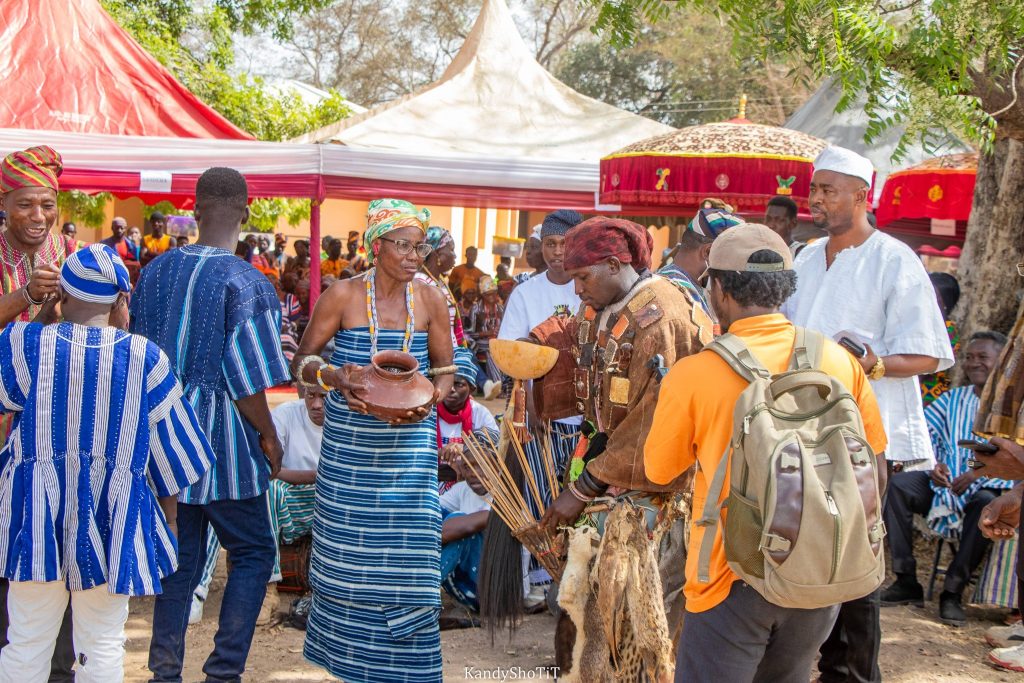
In modern times, the harvest cycle has given rise to the Fiok (Feok) Festival, first organised in Sandema in 1974. While rooted in ancient harvest rites, Fiok has evolved into a cultural festival that showcases Bulsa identity through music, dance, and traditional warfare displays.
Despite Christianity, education and modern farming methods, the core structure of the Bulsa ritual calendar remains intact. Even Christian households often continue traditional sacrifices, blending old and new belief systems rather than abandoning indigenous timekeeping altogether.
Indigenous Month Equivalents (Modern Approximations)
Although the traditional calendar does not formally count months, the following Buli month names are used today as seasonal references:
| Gregorian Month | Bulsa (Buli) Name | Meaning |
|---|---|---|
| January | ngoota chiik | Cold month |
| February | gunggona chiik | Funeral ceremonies month |
| March | vaala chiik | Month of empty millet stalks / field clearing |
| April | sambula chiik | Dawadawa flowering month |
| May | borik chiik | Sowing month |
| June | kpari chiik | Weeding month |
| July | naara chiik | Early millet month |
| August | za paala bogluta chiik | Early millet sacrifice month |
| September | chaung chiik | Chaung weeding month |
| October | sungkpaata chiik | Groundnut month |
| November | za cheka chiik | Millet harvest month |
| December | fanoai chiik / burinya chiik | Harvest sacrifices / Christmas month |
A Living Calendar of Identity
The Bulsa ritual calendar is more than a method of counting days, it is a living system that connects land, ancestors, food and faith. By organising time through farming cycles and ritual obligations, the Bulsa people preserve a worldview where survival, gratitude and community are inseparable.
As Buluk continues to modernise, this indigenous calendar remains a powerful symbol of cultural continuity, reminding future generations that time can be measured not only by clocks, but by life itself.
Reference
Kröger, F. (1986). The ritual calendar of the Bulsa (Northern Ghana). Anthropos, 81, 671–681.
NOTE:
If you are reading this article, and have relevant information to share to contribute to the history of Buluk; kindly leave a comment. Thank you.