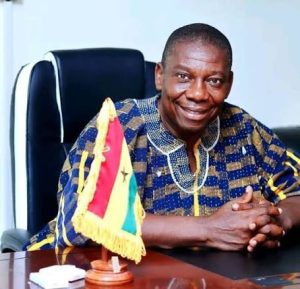
Long before the first bullet was fired at the Christiansborg Crossroads, a different kind of war was being waged in the Gold Coast (modern-day Ghana). It was a war of “economic resistance,” led not by a soldier, but by a visionary traditional chief and successful businessman: Nii Kwabena Bonne II.
Known to his people as the Osu Alata Mantse, Nii Bonne understood a truth that few dared to act upon in 1948: the British colonial empire’s greatest weakness was its wallet.
Following World War II, the Gold Coast was gripped by hyperinflation. Essential goods like sugar, flour, kerosene, and textiles—all imported from Europe—saw their prices skyrocket. These goods were controlled by a powerful cartel of European trading firms known as AWAM (Association of West African Merchants).
The term “AWAM” became so synonymous with price-gouging and exploitation that even today, in Ghanaian slang, “Awam” is used to describe something fake or deceptive.
Nii Kwabena Bonne II, a man of wealth and influence, was distressed by how the common Ghanaian was being squeezed by these foreign monopolies. In early January 1948, he took a bold stand. He didn’t call for a rebellion; he called for a Nationwide Boycott.
His message was simple: “If they won’t lower the prices, we won’t buy the goods.”
Starting on January 26, 1948, the boycott took hold. From the bustling markets of Accra to the rural villages of the interior, Ghanaians refused to buy imported European clothing, canned foods, and luxury items. The streets of the major cities fell quiet, and the massive warehouses of the European firms remained full of rotting stock.
The boycott was so effective that it paralyzed the colonial economy. The European merchants, seeing their profits vanish, were forced to do something they had never done before—negotiate with a traditional leader.
On February 11, 1948, a meeting was held between Nii Bonne, the colonial government, and the merchants. After intense pressure, the European firms agreed to reduce the profit margins on their goods, a massive victory for the people led by the “Boycott King.”
The boycott officially ended on February 28, 1948. Coincidentally, this was the same day that the famous 1948 Riots broke out after colonial police opened fire on unarmed ex-servicemen marching to Osu Castle.
While the boycott was non-violent, it proved to the people of the Gold Coast that they had the power to challenge the colonial system. It shattered the myth of European invincibility and provided the economic momentum that leaders like Dr. Kwame Nkrumah would later use to propel the nation toward full independence in 1957.
Nii Kwabena Bonne II remains a hero of Ghanaian history. He taught a nation that unity and economic discipline are just as powerful as any weapon. He wasn’t just a chief; he was a master strategist who proved that the road to freedom often begins in the marketplace.