The Battle of Kanjaga remains one of the most decisive confrontations in the history of northern Ghana, marking a turning point in the career of the feared Zabarima warlord Babatu. Fought on March 14, 1897, the battle was shaped by internal rebellion, European colonial competition, and resistance from local communities.
Origins of Conflict: Babatu’s Expansion and Control
Prior to the battle, Babatu had established dominance across several communities through violent raids. His attack on Kanjaga resulted in the defeat of local inhabitants and the capture of their chief, Amnu. The chief was later spared after pledging cooperation, likely providing supplies and logistical support to Babatu’s forces, who established camp near the settlement.
However, beneath this apparent control, tensions were rising within Babatu’s own ranks.
Internal Revolt: The Rise of Ameria
The most significant threat to Babatu came from within his army. A senior officer, Ameria, led a rebellion that would ultimately weaken the Zabarima war machine.
Ameria’s story is deeply rooted in the region’s complex history. Captured as a child from Santejan in the Sisala area, he rose through Babatu’s ranks but maintained strong ties with local communities, including the Bulsa and Sisala.
Several grievances fueled the mutiny:
- The sale of Grunchi women into slavery by Zabarima leaders
- The seizure of a Gonja woman from a Grunchi officer
- The withdrawal of tax exemptions and protections previously granted to local communities
These injustices united disgruntled officers and communities under Ameria’s leadership. Declaring himself “King of the Grunchi,” he established a rival base near Bachonsa, just a few kilometres from Babatu’s stronghold at Kanjaga.
Colonial Powers Enter the Scene
The conflict unfolded against the backdrop of increasing European involvement in the region. Both United Kingdom and France sought influence over northern territories.
British agents, including George Ekem Ferguson, had already secured treaties with several chiefs. However, British officers like Lieutenant Henderson and Captain Stewart faced unclear directives from Accra, limiting decisive action.
The British considered multiple alliances:
- Ameria, who had strong local support but aligned with the French
- Samori-linked forces, seen as a strategic threat to British expansion
- Babatu, viewed as a powerful but problematic figure
Despite attempts at negotiation, talks between Henderson and Babatu collapsed due to British opposition to slave raiding.
French Alliance and Escalation
Meanwhile, French commander Émile Chanoine advanced from Ouagadougou and allied with Ameria. The French reinforced their influence by symbolically raising their flag in nearby Doninga.
Babatu responded aggressively, attacking Doninga and burning the French flag, an act that escalated tensions and set the stage for open confrontation.
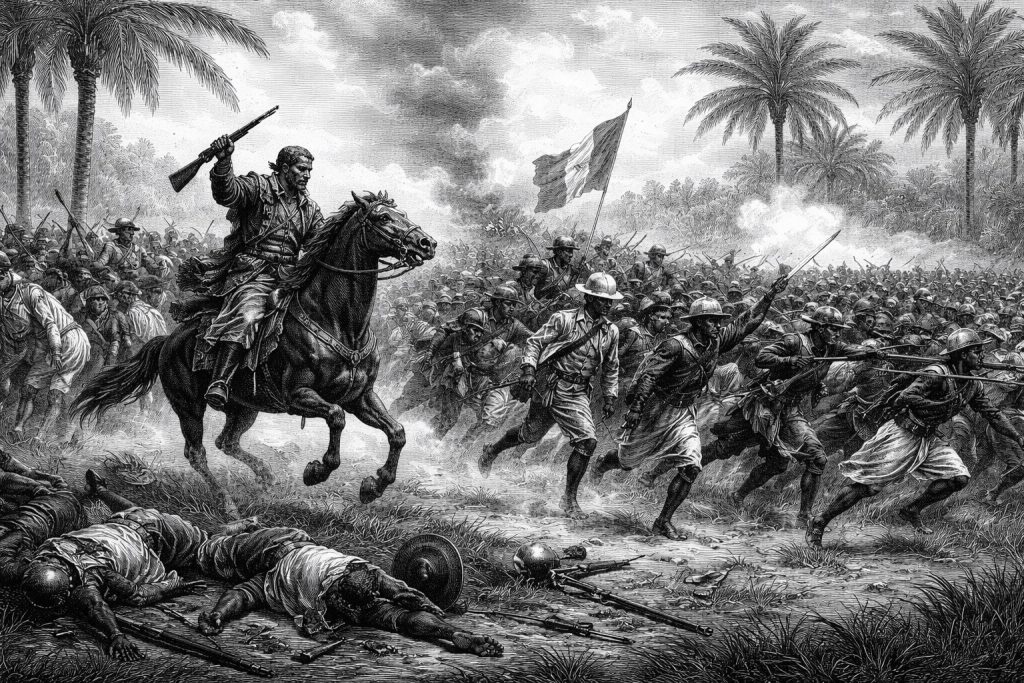
The Battle of Kanjaga: March 14, 1897
On March 14, 1897, French forces under Chanoine joined Ameria’s troops to confront Babatu near Ayiba.
Despite commanding a formidable force of approximately 400 riflemen and over 200 cavalry, Babatu suffered a crushing defeat. His army was decimated, and about 300 of his men were captured.
The battle marked a turning point, effectively ending Babatu’s dominance in the region.
Aftermath: Flight, Alliances, and Collapse
Following the defeat, Babatu fled to Yagaba, where he encountered British Captain Stewart, who granted him protection. Contrary to some oral traditions, historical records indicate that Babatu was not defeated by the British at this stage.
In a strategic move, the British later signed an agreement with Babatu, hoping to use him against French-aligned forces and the armies of Samori Touré.
Under the agreement, Babatu pledged to:
- End raiding activities
- Serve the British Crown
- Provide 500 men to the Gold Coast Constabulary
However, the alliance quickly collapsed. Facing shortages of food and supplies, Babatu resumed raids, attacking villages such as Bulienga and Ducie in June 1897.
This prompted British authorities to plan his arrest on charges of brigandage and murder.
Final Years and Death
After further military setbacks, including defeat at Gambaga, Babatu retreated to Yendi, a neutral zone between German and British territories.
There, the once-feared warlord abandoned warfare, reportedly settling into farming and building a home. Many of his former soldiers joined colonial forces, marking the decline of his military influence.
Babatu’s life came to an unexpected end in the early 1900s after a bite from a poisonous spider, bringing closure to the career of one of northern Ghana’s most notorious war leaders.
Historical Significance
The Battle of Kanjaga highlights the complex interplay between internal resistance and colonial ambition in West African history. It underscores how local rebellions, combined with European intervention, reshaped power dynamics and brought an end to one of the region’s most feared war regimes.
Today, Kanjaga remain a critical reference point in understanding pre-colonial resistance, colonial expansion, and the transformation of northern Ghana’s political landscape.