
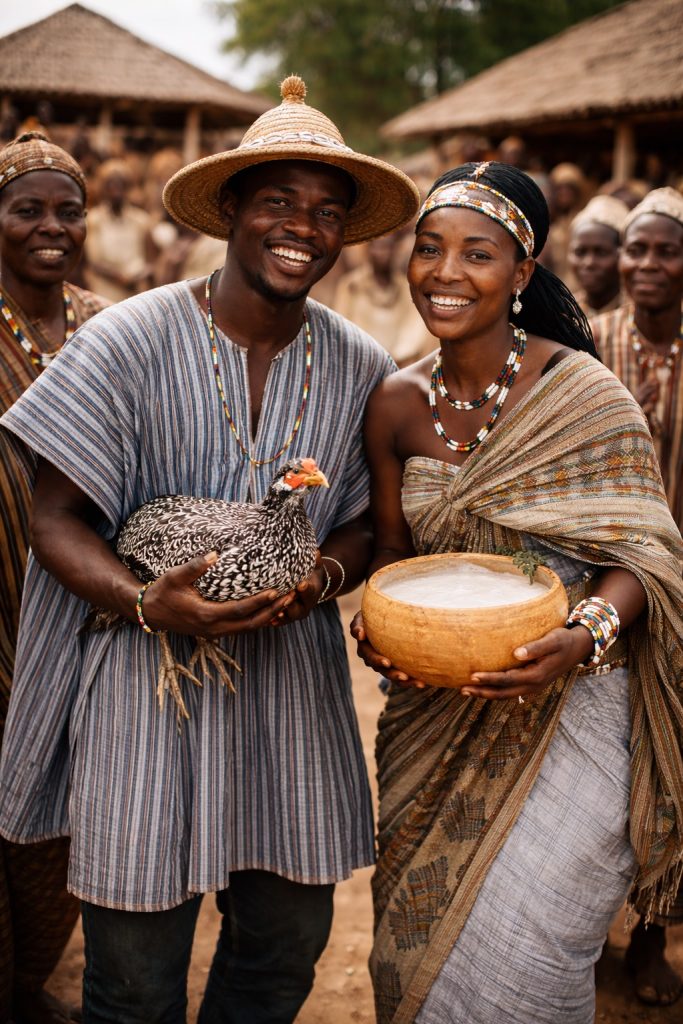
Marriage among the Bulsa of northern Ghana is far more than a personal commitment, it is a sacred cultural institution uniting two families and strengthening communal bonds. Unlike many societies that emphasize expensive bride price exchanges, the Bulsa uphold the principle that “nipouk ka fogli” (no woman is useless), so traditional marriage is intentionally simple, respectful, and rooted in clear customary phases.
The process unfolds in three core phases, dueeni-deka, akaayaali-ali-wa-boro, and nansiung-lika, led by family elders and close relations, with deep respect for tradition and the community’s values.
1. Dueeni-deka — The Courtship & Knocking Phase
The first phase, dueeni-deka, is the traditional courtship or knocking ceremony. It begins when a young man expresses interest in a woman, typically after meeting her at public events like markets, funerals, or festivals.
During this time, sexual intimacy is strictly forbidden until the marriage rites are completed. Once the man is certain he wishes to marry her, he visits her paternal home with one or two friends to formally show interest and meet her family.
Initial visits are courteous and respectful, involving greetings and symbolic gifts like cola nuts or money, but nothing heavy or demanding. The focus is on establishing rapport with the woman and her mother, who wields significant influence in the courtship process.
Once mutual interest is confirmed, the couple agrees on a day when the woman quietly leaves her home to join the suitor, and together they go to his compound. Here, the community celebrates with akuwaaliba — singing and merrymaking that publicly announces their union.
2. Akaayaali-Ali-Wa-Boro — Blocking Other Suitors
After the initial union celebration, the next step is akaayaali-ali-wa-boro, which literally means “blocking other suitors.” This phase makes the relationship known to the bride’s family formally and prevents other men from proposing once her choice has been made.
A trusted intermediary called a san-yigma (link-man), often an elder respected in both communities, carries the groom’s greetings and symbolic gifts, such as cola, tobacco, or small money, to the bride’s family.
The acceptance of these items signifies formal consent from the bride’s family and confirms that the woman is now considered married in the eyes of her lineage.
3. Nansiung-Lika — Closing the Gate of Marriage
The most significant and binding phase is nansiung-lika, which translates as “closing the gate”, a ritual representing the final sealing and lifelong commitment of the marriage.
Unlike the earlier stages, this rite is often conducted only after the couple has children or when they are fully certain of their long-term commitment. Its timing reflects the Bulsa belief that marriage should be fruitful and lifelong.
Again performed by the san-yigma, the groom presents traditional items, historically cola, tobacco and a hen, to the woman’s family. If the woman has borne children, livestock such as a sheep may replace the hen. Once accepted by the elders, the marriage is considered fully consummated in customary terms.
Cultural Meaning & Respect for Tradition
For the Bulsa, these stages are not just rituals but deep social rites that reinforce respect, family unity, and cultural continuity. Unlike some neighboring groups that emphasize high bride price, the Bulsa tradition emphasizes respect for the woman, community involvement, and enduring family bonds.
The entire process, from courtship to sealing, strengthens inter-family relationships and ensures that marriage remains a community-supported institution rather than a transactional one.
Conclusion
The traditional marriage process of the Bulsa people is a rich cultural tapestry woven with respect, ritual symbolism, and shared community values. Its simplicity and emphasis on mutual respect make it a powerful example of how traditional practices can enrich marital life. While modern influences have introduced some changes, the core Bulsa process continues to reflect the values, dignity, and cultural identity of the people.
Source:
Atuick, Evans Akangyelewon. “The Tradition and Change in the Bulsa Marriage Process: A Qualitative Study.” Buluk.de, section THE TRADITIONAL MARRIAGE PROCESS, accessed January 2026, https://www.buluk.de/Buluk8/Marriage.htm






Wow, perfectly much