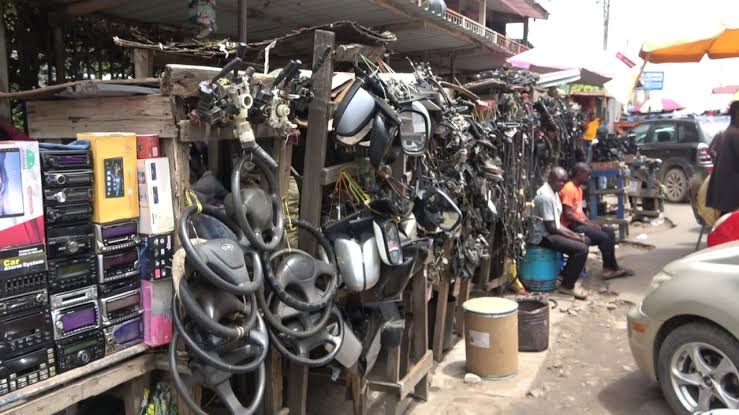
The Abossey Okai Spare Parts Dealers Association has rejected claims that rising spare parts prices are responsible for the proposed 30% increase in commercial transport fares in Ghana.
The association described claims attributed to the Ghana Private Road Transport Union (GPRTU) and the Ghana Road Transport Coordinating Council (GRTCC) as false and misleading, insisting that spare parts prices have not increased significantly enough to justify the proposed fare adjustment.
The dispute comes after the GPRTU proposed a 30% increase in public transport fares, citing rising operational costs facing commercial vehicle operators. The proposal has been submitted for consideration and remains subject to discussions with the relevant authorities.
Abossey Okai dealers deny spare parts price increases
According to the Abossey Okai Spare Parts Dealers Association, there has been no increase in spare parts prices that could reasonably explain the proposed transport fare adjustment.
The dealers said prices of essential vehicle components, including engine oil and filters, have remained stable, while stock levels at the Abossey Okai spare parts market have also remained steady.
They further argued that there have been no significant changes in import duties or prevailing market conditions that would support claims that rising spare parts costs are driving higher transport fares.
The association therefore urged the public to disregard what it described as misleading claims linking spare parts prices at Abossey Okai to the proposed fare increase.
Dealers question basis for linking Abossey Okai to fare hike
The spare parts dealers have also questioned why Abossey Okai has been cited as a major factor behind increased vehicle maintenance costs.
The association noted that some commercial transport operators have themselves indicated that they purchase spare parts online rather than directly from dealers at the Abossey Okai spare parts hub.
It therefore questioned the basis for attributing the proposed 30% increase in transport fares to the prices of spare parts sold at the market.
GPRTU cites rising operating costs
The proposed fare increase follows growing concerns among commercial transport operators about the cost of running vehicles.
The GPRTU has attributed the proposed adjustment to rising operating expenses, including fuel, vehicle maintenance, spare parts, lubricants and insurance.
The union has also pointed to pressures on transport operators despite a government intervention aimed at reducing the impact of diesel prices by absorbing GH¢2 per litre.
However, the proposed 30% increase is not yet a final approved fare adjustment. Further discussions and negotiations with relevant stakeholders are expected before any new fares are formally determined.
Abossey Okai dealers call for transparent fare discussions
The Abossey Okai Spare Parts Dealers Association has called for greater transparency in discussions surrounding transport fares.
It wants government regulators, transport unions and other stakeholders to rely on verifiable economic indicators when determining whether an increase in fares is justified.
The association argued that any adjustment should accurately reflect actual changes in the cost of operating commercial vehicles rather than relying on what it considers unsupported claims about spare parts prices.
It also urged stakeholders to involve all relevant parties in the discussions to ensure that any eventual fare adjustment is fair to both transport operators and commuters.
What the 30% transport fare proposal means for commuters
The proposed 30% fare increase could have a significant impact on commuters if eventually approved, particularly amid concerns over the rising cost of living.
For now, however, the dispute has introduced another dimension to the debate, with spare parts dealers challenging one of the cost factors cited by transport operators.
The final decision on any transport fare adjustment will depend on consultations among the government, transport unions and other stakeholders.
Until that process is completed, commuters should continue to rely on officially announced fares rather than assuming that the proposed 30% increase has already taken effect.