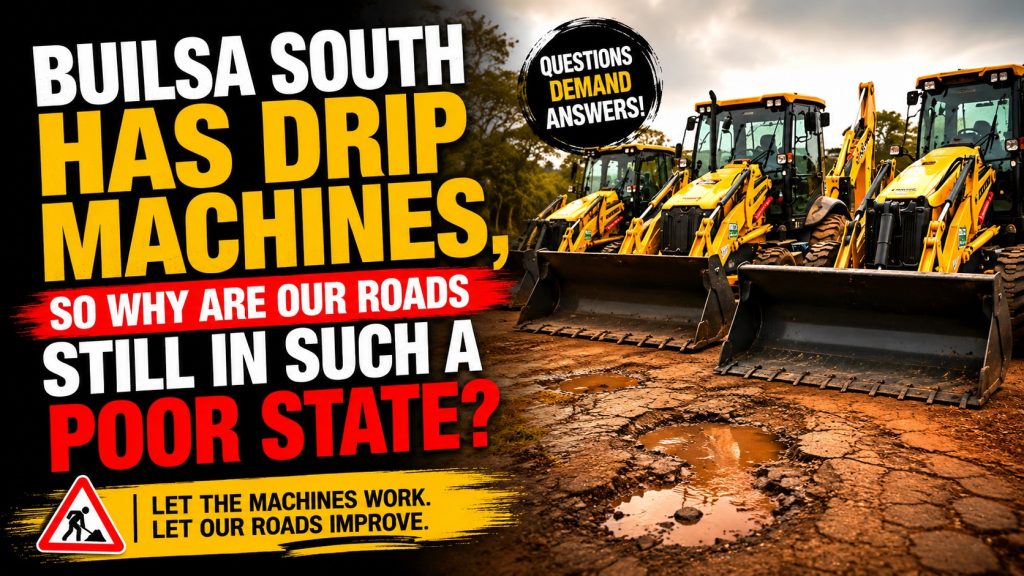
There comes a point when citizens must ask difficult but necessary questions about the development of their communities. This is one of those moments.
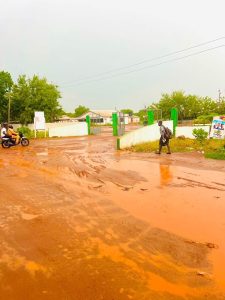
As a proud son of Buluk and someone who deeply cares about the future of the Builsa South District, I find it increasingly difficult to understand why many of our roads remain in deplorable condition despite the availability of machinery specifically provided to rehabilitate them. Every day, motorists, commercial drivers, farmers, teachers, traders, health workers and ordinary residents endure the frustration of travelling on roads that have become increasingly dangerous, especially now that the rainy season has set in.
What makes this situation even more troubling is that Builsa South is not without the equipment needed to maintain these roads. Through Ghana’s District Road Improvement Programme (DRIP), the district received modern road construction machinery intended to improve feeder roads and other critical access routes. The programme was introduced to empower Metropolitan, Municipal and District Assemblies (MMDAs) to undertake routine road maintenance, reduce dependence on external contractors and improve connectivity between communities.
The vision behind the programme was commendable. By placing heavy-duty equipment directly in the hands of district assemblies, government sought to ensure that deteriorating roads could be repaired promptly, thereby supporting agriculture, commerce and rural development. Every district was expected to benefit from this intervention, and Builsa South was no exception.
This naturally raises a question that many residents continue to ask:
If the district has the machines, why are our roads still falling apart?
Across Builsa South, numerous roads linking our communities have deteriorated considerably over the past months. Deep potholes have become common features on roads that thousands of residents rely on every day. What were once manageable sections have now become hazardous, particularly during the rainy season when floodwaters conceal potholes and weaken already damaged surfaces. Travelling between communities has become slower, more expensive and, in many cases, more dangerous.
These poor road conditions are affecting every sector of our local economy. Farmers struggle to transport foodstuffs from their farms to markets. Commercial drivers spend more money repairing damaged suspension systems and tyres. Teachers posted to rural schools face unnecessary hardship in reaching their workplaces, while health professionals often encounter delays in responding to emergencies. Traders transporting goods to and from markets absorb higher transportation costs, costs that are eventually passed on to consumers.
Perhaps nowhere is the impact felt more than at the Fumbisi Market.
The Fumbisi Market remains one of the most important commercial centres in northern Ghana, attracting traders and buyers from different parts of the country, particularly during its famous six-day market. It has enormous potential to drive economic growth, create employment and increase incomes for thousands of families. However, no market can realise its full potential when the roads leading to it continue to deteriorate. Good roads reduce transportation costs, encourage investment and make markets more accessible. Poor roads achieve exactly the opposite.
It is for these reasons that I believe the people of Builsa South deserve clear answers from the District Assembly.
What is the current operational status of the DRIP machines allocated to the district? Are all the machines functional? If they are, how frequently have they been deployed to rehabilitate roads within the district? Which communities have benefited from their use since they were commissioned? If the machines are not being deployed, what challenges are preventing them from fulfilling the purpose for which they were acquired?
These are not questions intended to score political points. They are legitimate questions about accountability and the management of public resources. The equipment was purchased with public funds for the benefit of the people, and citizens have every right to know how those assets are being utilised.
In recent months, rumours have circulated across Buluk alleging that some of the DRIP machinery is being used to fetch sand for private building contractors instead of rehabilitating public roads. At this stage, these remain unverified allegations, and it would be irresponsible to present them as established facts. Nevertheless, when such claims become widespread within a community, public officials have a responsibility to address them openly and transparently. If the allegations are false, the District Assembly and the DRIP Coordinator should provide clear information on how the machines are currently being used and reassure the public that the equipment remains dedicated to its intended purpose. Transparency is often the most effective response to speculation.
As citizens, we also have a responsibility to speak up whenever development appears to be stalling. Constructive criticism should never be mistaken for hostility. Democracy flourishes when citizens hold public institutions accountable while remaining respectful and solution-oriented. Remaining silent in the face of persistent challenges does not promote development; rather, it allows problems to become entrenched.
This is why I respectfully call on the District Chief Executive of the Builsa South District to make road rehabilitation an immediate priority. The rainy season has already begun, and every delay increases the cost of future repairs while exposing road users to greater danger. The DRIP Coordinator should be directed to deploy the available machinery to rehabilitate the most critical roads connecting our communities, particularly those that serve farmers, traders and essential public services.
The people of Builsa South are not asking for miracles. They are simply asking to see public resources being used for the purpose for which they were intended. They do not want endless explanations about what will be done in the future while the roads continue to deteriorate. They want visible action. They want to see graders reshaping damaged roads, rollers compacting repaired surfaces, loaders clearing blocked sections and tipper trucks transporting gravel to areas that have become almost impassable.
Development is measured not by the number of machines a district possesses, but by the impact those machines have on the lives of ordinary people.
If our roads continue to deteriorate while road maintenance equipment remains idle, or is perceived to be serving purposes other than public road rehabilitation, then we are failing to maximise an opportunity that was intended to improve the lives of our people.
Buluk deserves better. Our farmers deserve better. Our traders deserve better. Our teachers, nurses, drivers and schoolchildren deserve better.
The time has come to move beyond speeches and promises. Let the DRIP machines work. Let our roads be rehabilitated. Let our communities become safer, more connected and better positioned to realise their full economic potential.
Only then will the true purpose of the District Road Improvement Programme be fulfilled.
Shalom.
Akunye Michael
Concerned Citizen of Buluk