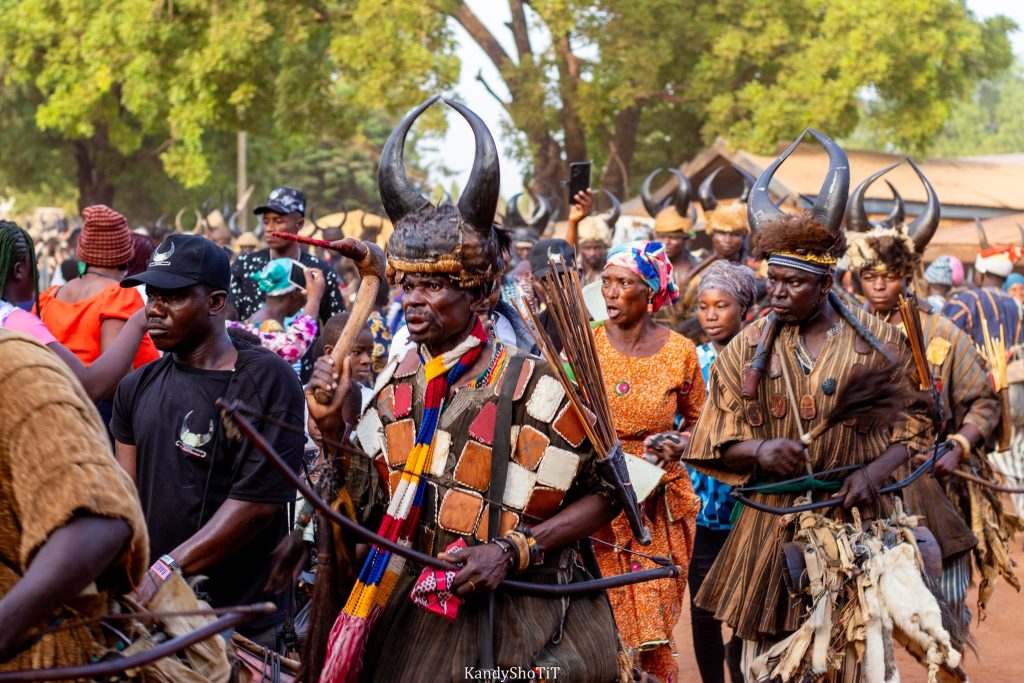
Every December, the town of Sandema comes alive with rhythmic war dances, ancestral chants, and striking costumes that tell a powerful story of resistance, survival, and identity. At the heart of the annual Feok Festival is a unique form of regalia whose origins trace back to one of the most defining moments in the history of the Bulsa people.
According to a peer-reviewed cultural study by Lucy Agaasa and Hager Ampa-Korsah, the Feok festival costumes were originally developed by Builsa warriors, traditional leaders, and ancestors during the 18th-century resistance against slave raiders led by the notorious Babatu.
Costumes Born Out of War
Unlike many ceremonial outfits in Ghana, Feok costumes were not created for aesthetics alone. They were designed as protective war gear, combining spiritual and physical defense. The costumes, often made up of talisman-studded smocks, reinforced hats, pantaloons, waist belts, and horned headgear, were believed to offer protection against bullets, arrows, and spiritual attacks during battle.
Researchers found that over 95% of respondents interviewed in the study affirmed that these costumes originated from the forefathers of the Bulsa people, while 50% specifically credited the warriors who fought Babatu and his Zabarima slave raiders in the late 1800s.
From Battlefield to Festival Grounds
Following the defeat of the slave raiders, the Feok costume gradually transitioned from war attire to a symbol of victory, emancipation, and unity. Today, it plays a central role in the Feok Festival, which also serves as a thanksgiving celebration for a successful farming season. In the Buli language, Feok translates to “abundance of food,” reinforcing the festival’s agricultural and spiritual significance.
The climax of the festival features dramatic war dances that reenact historical battles, with performers clad in full Feok regalia, turning history into living memory for younger generations.

Cultural Identity and Social Significance
Beyond its visual appeal, the Feok costume carries deep cultural meaning. About 90% of respondents in the study indicated that the costume instills bravery and strengthens unity among the Builsa people. Each component has symbolic relevance:
- Smocks provide spiritual protection
- Horned hats inspire courage and intimidate enemies
- Waist belts secure weapons and essentials during combat
These elements collectively reinforce the identity and warrior heritage of Buluk Feok costumes.
Economic and Tourism Value
The Feok costume has also become a vital cultural tourism asset in the Upper East Region. Over 70% of respondents confirmed that the uniqueness of the costume attracts tourists, researchers, and cultural enthusiasts to Sandema during the festival period.
Costume makers and textile producers benefit economically through the sale of handwoven fabrics and festival regalia Feok costumes.
Preserving a Fading Heritage
Despite its importance, scholars warn that the knowledge surrounding the Feok costume remains largely oral and confined to elderly custodians. Without proper documentation and preservation, vital aspects of its history risk being lost.
The study recommends the establishment of a Feok cultural museum in Sandema to preserve historic regalia for research, tourism, and future generations, a call that cultural advocates say deserves urgent attention Feok costumes.
A Living Symbol of Buluk’s Resilience
More than a costume, Feok regalia represents freedom, resistance, and pride. As modernization and globalization continue to reshape cultural practices, the Feok Festival stands as a reminder that Buluk’s history is not just remembered, it is worn, danced, and celebrated.
Source: Adapted from “Feok Festival Costumes: Evolution & Socio-Cultural Importance” by Lucy Agaasa & Hager Ampa-Korsah, Journal of Culture, Society and Development, Vol. 24 (2016)
As cited, this article is adapted from a study by Agaasa, and Ampa-Korsah in 2016. If you have more information to share about the feok costumes, let us know by commenting.
You can also share an article of any area of culture of the Bulsa people, and we will publish it for you.