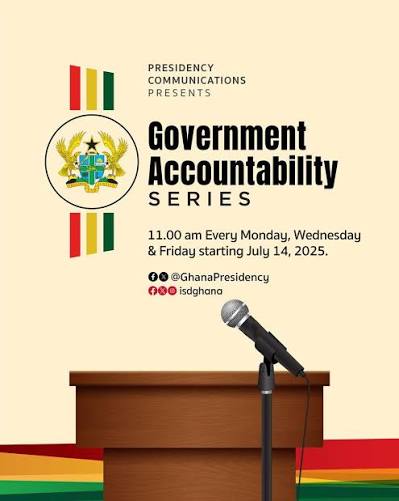
In every democratic republic, accountability is the cornerstone of governance. Citizens entrust leaders with power not for personal gain, but to advance the public good. Ghana’s recent experiment with transparency—the Government Accountability Series (GAS)—is a bold step in that direction, and one that IMANI Africa has critically examined in its latest brief.
Launched under the Mahama-led National Democratic Congress (NDC) government, GAS was part of a broader “Reset Ghana” initiative. It created a platform where Ministers of State regularly brief the public on their ministries’ actions and inactions. More than a symbolic gesture, GAS has illuminated the workings of previously obscure ministries and offered fresh insights into those frequently in the spotlight.
For the average Ghanaian, GAS is a window into the machinery of government. It bypasses traditional channels like the Right to Information Act (Act 989), Parliamentary Question Time, and sporadic briefings from the Information Ministry. Instead, it reframes accountability as a direct encounter—duty bearers facing the people.
However, innovation rarely comes without friction. The Attorney General and Minister of Justice has used GAS to update the public on ongoing criminal cases, drawing criticism for potentially prejudging suspects. The Office of the Special Prosecutor (OSP) has faced similar scrutiny, particularly in high-profile cases like that of former Finance Minister Ken Ofori-Atta. Critics argue that these updates risk shifting the battleground from the courtroom to the media.
This tension raises a fundamental question: Should the fight against corruption be confined to legal proceedings, or do duty bearers owe citizens regular updates? IMANI’s brief suggests that corruption is not just a legal issue—it’s also about perception. In governance, perception shapes legitimacy as much as reality. Silence breeds mistrust; informed citizens, even imperfectly, are more likely to trust institutions.
The challenge lies in balancing two imperatives: the public’s right to know and suspects’ right to a fair trial. Transparency must not devolve into trial by media, yet opacity must not shield misconduct. Ghana’s accountability architecture must evolve communication strategies that inform without prejudicing, educate without sensationalizing, and build trust without compromising justice.
Ultimately, GAS and the OSP’s briefings represent a redefinition of the relationship between state and citizen. They affirm that accountability is not a privilege granted by leaders—it is a duty owed to the people. While criticisms are valid, they should refine—not derail—these initiatives. Ghana’s democratic journey depends on mechanisms that are both transparent and just.