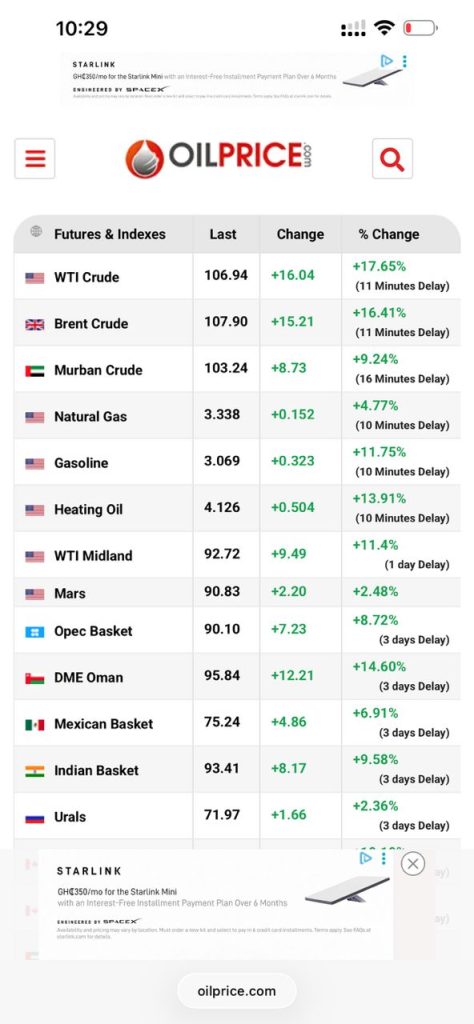
Global oil prices have surged past $100 per barrel, sending shockwaves through international energy markets as tensions in the Middle East intensify following a major military confrontation involving the United States, Israel, and Iran.
The sharp increase in oil prices comes after the United States and Israel launched a large-scale military campaign known as Operation Epic Fury against Iran, dramatically escalating geopolitical tensions in one of the world’s most strategically important energy regions.
Operation Epic Fury Sparks Global Tensions
According to reports, the operation resulted in the killing of Ali Khamenei, Iran’s Supreme Leader, along with several high-ranking regime officials. The development triggered immediate retaliation from Tehran, raising fears of a broader regional conflict.
Iran reportedly responded with missile strikes targeting Israel and several countries across the Gulf region, further heightening global security concerns and threatening the stability of energy supply routes.
Energy analysts say the escalating confrontation has placed global oil markets on high alert, with traders reacting rapidly to potential disruptions in supply.
Strait of Hormuz at the Center of Energy Security Concerns
A key focus of the crisis is the Strait of Hormuz, one of the world’s most critical maritime corridors for energy transport.
Nearly one-fifth of the world’s oil and liquefied natural gas (LNG) passes through the Strait of Hormuz, making it a vital artery for global energy supply.
Stephen Innes of SPI Asset Management described the route as “the aorta of the global energy system,” emphasizing its strategic importance to global markets.
Security concerns in the region have already begun to disrupt energy infrastructure.
Operations at Ras Tanura Refinery, Saudi Arabia’s largest oil refinery, were reportedly halted after a drone strike. Meanwhile, QatarEnergy temporarily suspended liquefied natural gas production due to security threats.
Maritime security authorities have also reported multiple attacks on vessels operating across the Gulf.
Shipping Routes Disrupted as Global Trade Feels the Impact
The conflict is also affecting international shipping routes. Danish shipping giant Maersk announced it will divert vessels away from the Suez Canal, instead routing them around the Cape of Good Hope.
The decision is expected to significantly increase shipping times and freight costs, potentially affecting global trade and supply chains.
Gold Prices Hit Record High
Amid growing geopolitical uncertainty, investors have rushed into safe-haven assets. Gold prices have surged to a record $5,426 per ounce, reflecting rising fears in financial markets.
The spike in gold prices could benefit major African producers, particularly Ghana and South Africa, both of which are among the world’s leading gold exporters.
Inflation Risks Loom as Oil Prices Rise
Economists warn that sustained high oil prices could drive global inflation higher by increasing the cost of transportation, food production, and industrial commodities.
Market volatility has also increased sharply. The CBOE Volatility Index, widely known as the market’s “fear gauge,” has jumped by nearly 17 percent, signaling heightened investor anxiety.
If energy prices continue to climb, central banks may be forced to delay planned interest rate cuts, potentially slowing global economic recovery.
Mixed Outlook for African Economies
For many African economies that rely heavily on commodity exports, the crisis presents both opportunities and risks.
While higher oil and gold prices may boost national revenues for resource-rich countries, consumers across the continent could face rising fuel costs and increased living expenses if the conflict persists.
Analysts say the situation remains highly volatile, with global markets closely monitoring developments in the Middle East and the potential impact on energy supply routes and international trade.