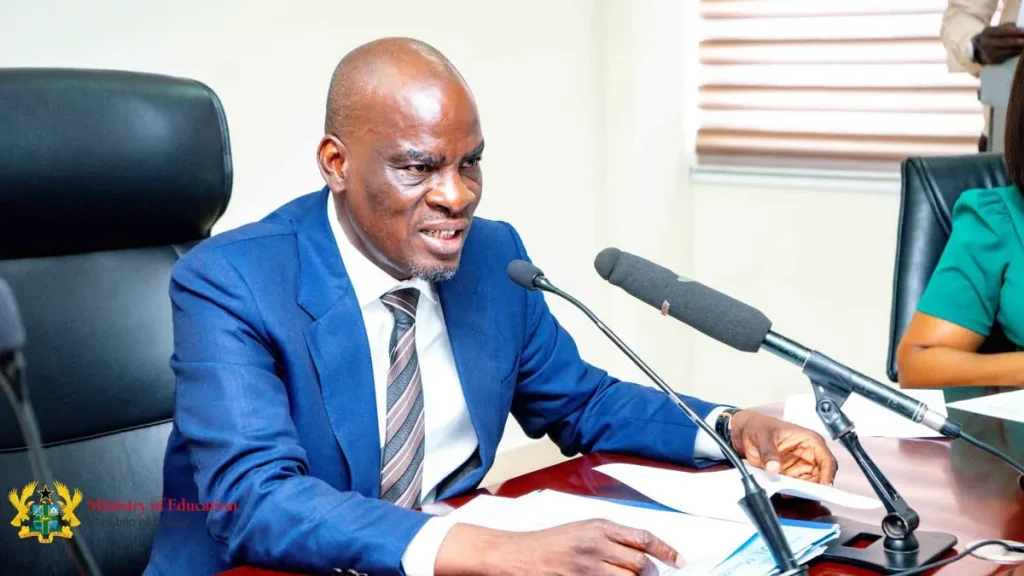
The Minister for education Hon. Haruna Iddrisu shared his view on the appointment of Emelia Afi Agbenyo and Dr Joseph Kwaku Asamoah, who were sworn into office by President Mahama on Monday, October 12, 2026.
According to Hon Haruna Iddrisu, the debate surrounding the appointments raises broader questions about the constitutional framework governing eligibility for membership of Ghana’s Electoral Commission.
Speaking to newsmen in Accra on Monday October 13, He maintained that although the appointments are constitutionally appropriate, the political concerns being raised by sections of the public cannot simply be dismissed.
Hon.ddrisu disclosed that he knows Agbenyo well and had worked with her before her appointment to the Electoral Commission.
He explained that, as of Monday, Agbenyo was serving under his ministry through the Ghana TVET Service as Deputy to the Chief Executive.
The Education Minister questioned whether the existing constitutional arrangements sufficiently define the parameters for determining who should be eligible for appointment to the Electoral Commission.
“Is it constitutionally appropriate? Those are the questions you should ask,” Iddrisu said,
He also raised questions about the extent of the President’s appointment powers under the Constitution, particularly in relation to the appointment of officials to the Electoral Commission.
However, the constitutional provision specifically governing these appointments is Article 70(2), which requires the President to act on the advice of the Council of State when appointing the EC Chairperson, Deputy Chairpersons and other members.
Articles 43 and 44 address the Commission’s composition and the qualifications required for membership, while Articles 45 and 46 cover its functions and independence.
The minister argued that Ghana needs stronger legislative provisions to define the eligibility requirements for individuals seeking positions on the Electoral Commission.
He observed that one of the country’s challenges has been the failure to use legislation effectively to establish clear parameters for eligibility.
According to him, defining such requirements could help address public concerns and strengthen confidence in the electoral management body.
The debate touches on an important question in Ghana’s democratic governance: whether the existing constitutional and legal framework provides sufficient safeguards to ensure that appointments to the Electoral Commission command public confidence across the political divide.
Under Ghana’s constitutional framework, the President appoints the Commission’s leadership on the advice of the Council of State. The Commission is also constitutionally protected from the direction or control of any person or authority in the performance of its functions, subject to the Constitution and applicable law.
The law maker stressed that his primary concern is the preservation of democratic values and the independence of the Electoral Commission.
He said he wanted an institution that would not endanger Ghana’s democratic ethos and values, emphasising the need for independent, courageous and transparent individuals to serve on the Commission.
His comments place the spotlight on the importance of public trust in electoral institutions, particularly as the Commission remains responsible for managing elections, maintaining the voters’ register, demarcating electoral boundaries and educating citizens on electoral processes.
The credibility of an electoral management body depends not only on the legal procedures governing appointments but also on public confidence in its ability to perform its duties impartially.
The Education Minister also pointed to President Mahama’s constitutional review initiative, suggesting that significant political and economic reforms could follow.
Iddrisu indicated that Parliament could consider two important bills: one seeking to amend entrenched provisions of the 1992 Constitution and another seeking to amend non-entrenched provisions.
He presented these anticipated legislative developments as part of a wider reform agenda that could address some of the institutional and constitutional questions facing the country.
The question of how members of the Electoral Commission are appointed has featured in Ghana’s broader constitutional reform debate. In December 2025, the Constitution Review Committee recommended changes to the appointment process, including a proposal for parliamentary approval of nominees following an open and competitive selection process.
Despite defending the appointments on constitutional grounds, Iddrisu acknowledged that the political dimension of the debate remains important.
He said citizens and political actors have the right to remind public officials of the need to demonstrate fairness and consistency in their actions.
“I think that the appointment is constitutionally appropriate, but politically, people have the right to remind us that if you seek equity, do equity,” he stated.
The remark captures the distinction between the legality of an appointment and the public debate over whether the process inspires confidence in the neutrality of the Electoral Commission.
While constitutional compliance establishes the legal framework for appointments, questions about fairness, transparency and institutional independence remain central to public discussion.