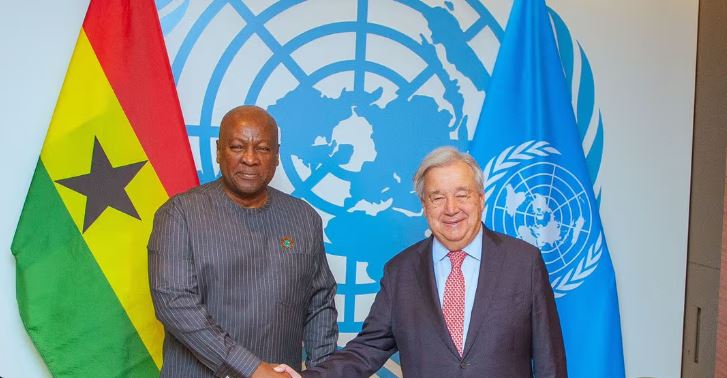
President John Dramani Mahama has urged nations to support a landmark United Nations resolution on the transatlantic slave trade, emphasizing that the vote represents a critical opportunity to restore the dignity and humanity of millions of victims.
Speaking ahead of the vote at the United Nations, Mahama stressed that the resolution goes beyond symbolism and serves as a moral reckoning with one of the darkest chapters in human history. He called on member states to “stand on the right side of history” by endorsing the initiative aimed at formally recognizing the scale and enduring impact of slavery.
A Moral Imperative for Justice
Mahama underscored that the transatlantic slave trade was not merely historic, but a systemic injustice that stripped millions of Africans of their identity, dignity, and fundamental human rights. He argued that acknowledging this truth through a global vote is essential to restoring the humanity of those who suffered.
According to him, the resolution offers a pathway toward healing, reconciliation, and justice, not only for Africa but for the global African diaspora. He emphasized that recognition must be accompanied by meaningful dialogue on reparative justice, including apologies, restitution, and structural reforms to address lasting inequalities.
Ghana Leads Global Push for Reparative Justice
Ghana, under Mahama’s leadership and in collaboration with the African Union and Caribbean partners, has been at the forefront of the global reparations movement. The proposed resolution seeks to declare the transatlantic slave trade as one of the gravest crimes against humanity, highlighting its scale, duration, and long-term socio-economic consequences.
The initiative aligns with broader continental efforts, including the African Union’s reparations agenda, which aims to unify African states in demanding accountability and redress for historical injustices.
Global Support and Divisions
The resolution has attracted widespread international backing, with over 120 countries supporting its adoption at the UN General Assembly. However, it has also exposed divisions, as some Western nations have expressed concerns over the implications of reparations and historical accountability.
Despite these differences, Mahama remains optimistic that the vote will mark a turning point in global consciousness, shifting from mere acknowledgment of slavery to concrete steps toward justice.
Restoring Humanity Through Action
Mahama concluded that the UN vote is not about assigning blame to present generations but about confronting historical truths and their present-day consequences. He insisted that restoring the dignity of victims requires collective action, honesty, and a commitment to building a more equitable global order.
“This is a moment for humanity to correct the moral record,” he indicated, urging nations to ensure that the suffering of enslaved Africans is neither forgotten nor diminished, but honored through decisive international action.