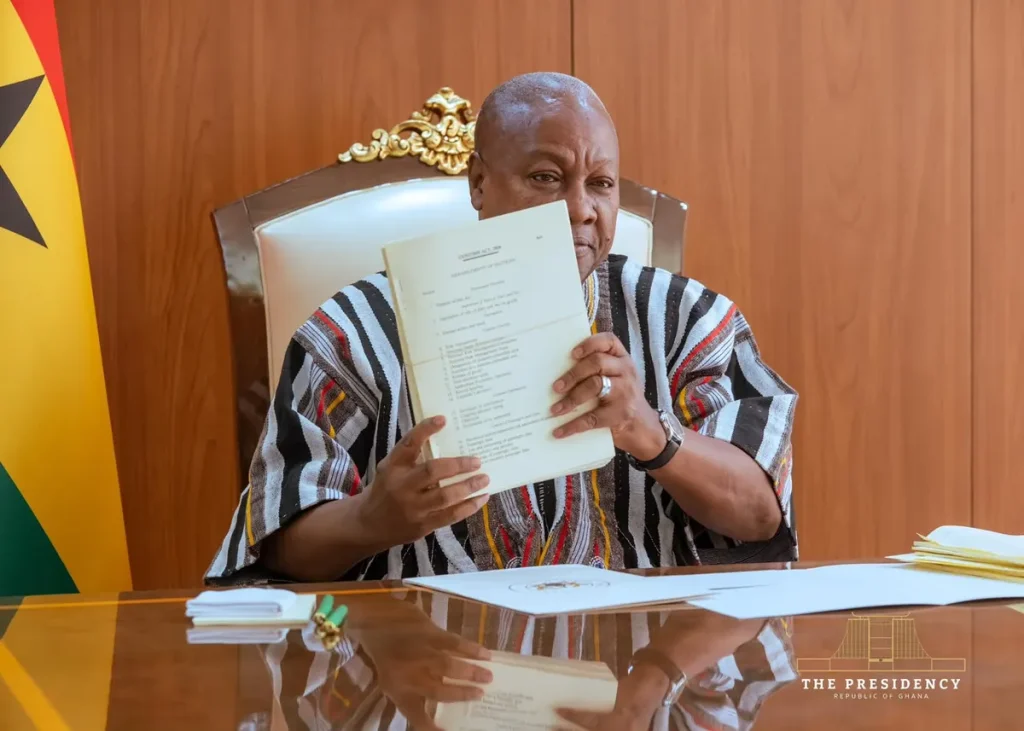
President John Dramani Mahama says Ghana’s newly enacted Community Service Act, 2026 will help save taxpayer funds by introducing non-custodial sentences for people convicted of minor offences.
The President explained that the legislation forms part of broader reforms aimed at modernising Ghana’s justice system, reducing pressure on the country’s prisons and ensuring that public funds are used more efficiently.
President Mahama made the remarks after signing 10 new laws into effect as part of his government’s legislative reform programme.
Community service to replace imprisonment for minor offences
Under the Community Service Act, 2026, courts can impose non-custodial sentences on offenders convicted of misdemeanours and other less serious offences.
Rather than sending eligible offenders to prison, the law provides for them to undertake community service for the period determined by the court.
President Mahama said the approach would reduce the financial burden associated with keeping people in prison, particularly in cases involving relatively minor offences.
He argued that it would be unnecessary for the state to bear the cost of feeding, housing and maintaining offenders in prison when community service could serve as an alternative form of punishment and rehabilitation.
The President said the new system would allow offenders to contribute positively to their communities while serving their sentences outside prison.
Prison congestion
The introduction of non-custodial sentences is also expected to help address congestion within Ghana’s correctional facilities.
The government has identified prison decongestion as one of the potential benefits of the new legislation, particularly by ensuring that people convicted of minor offences do not occupy limited prison spaces that could be reserved for more serious offenders.
The reform therefore represents a shift towards a justice system that places greater emphasis on proportionate punishment, rehabilitation and the efficient use of state resources.
Part of wider justice reforms
The Community Service Act is one of 10 laws President Mahama recently signed as part of efforts to reform various sectors of the Ghanaian economy and public administration.
Other legislation signed by the President includes the Tribunals Act, 2026, which provides for the establishment of Regional Tribunals to deal with specified categories of offences.
The Maritime and Related Offences Act, 2026 also provides a legal framework for prosecuting offences committed within Ghana’s territorial waters and incorporates relevant obligations under the United Nations Convention on the Law of the Sea.
The package further includes the National Defence University Act, 2026, the Customs Act, the Income Tax Amendment Act, the Energy Sector Levies Amendment Act, the Ghana Cocoa Board Act, the Value Added Tax Amendment Act and the Excise Act.
What the Community Service Act means for Ghana
The new law could have significant implications for Ghana’s criminal justice system.
For eligible offenders, a community-based sentence could mean avoiding imprisonment while still being held accountable for their actions. For the state, it could reduce some of the costs associated with maintaining inmates and ease pressure on correctional facilities.
The government also views the legislation as an opportunity to promote more constructive forms of rehabilitation for people who commit less serious offences.
President Mahama’s comments highlight the government’s position that punishment for minor offences should not unnecessarily impose additional financial pressure on the taxpayer when alternative sentencing options are available.
The effective implementation of the Community Service Act, 2026 will now be important to determine how significantly the legislation contributes to prison decongestion, rehabilitation and savings to the public purse.