VOB raises questions over GH¢50,000 allocated to Kanjarga–Fumbisi Road as concerns emerge over pothole repairs, technical supervision and value for money.
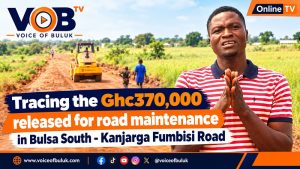
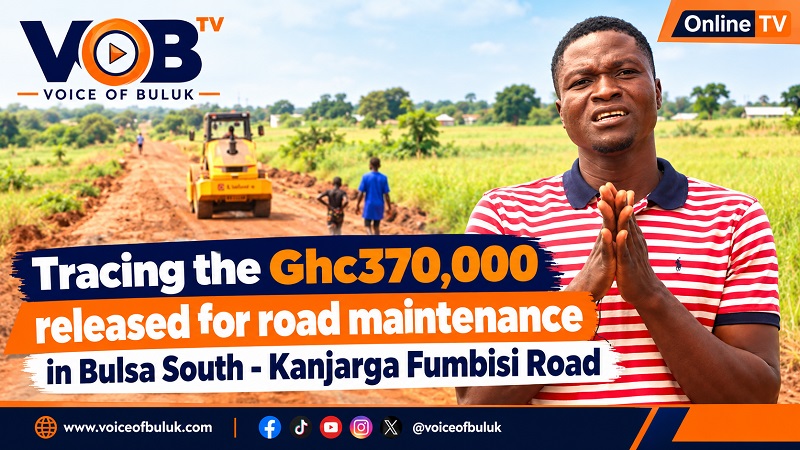
Voice of Buluk has commenced an accountability exercise to track the use of GH¢370,000 reportedly released by the Member of Parliament for Bulsa South for the maintenance of potholes on roads across the constituency.
As part of the exercise, the Voice of Buluk team visited the Kanjarga–Fumbisi Road to assess the maintenance work carried out on the stretch, which was allocated GH¢50,000 from the reported road maintenance fund.
The visit forms part of the media organisation’s commitment to promoting transparency, public accountability and value for money in the use of public resources.
Kanjarga–Fumbisi Road: Potholes Filled, but Questions Remain
During the inspection, the team observed that major potholes along sections of the Kanjarga–Fumbisi Road had been filled with gravel.
While the intervention appears to have addressed some of the immediate problems confronting road users, questions remain about the quality, durability and technical adequacy of the repairs.
Although gravel filling may provide temporary relief, its ability to withstand heavy rainfall, runoff and regular traffic will depend on the quality of the materials used, the preparation of the road surface, drainage conditions and the maintenance method adopted.
With the next rainy season approaching in the coming months, an important question remains: Will the repairs withstand the rains, or will the potholes reappear after the money has been spent?
For residents and commuters who depend on the road, the real measure of success is not simply whether potholes have been filled today, but whether the intervention provides a durable improvement in road conditions.
Voice of Buluk acknowledges the work observed on the road but maintains that the long-term effectiveness of the repairs must be assessed against appropriate technical standards and the resources allocated to the project.
DRIP Machine Operators Observed, Technical Supervision Unclear
Another observation made during the visit was that the workers seen carrying out the road maintenance activities were operators of machines under the District Road Improvement Programme (DRIP).
However, the team did not observe a technical expert supervising the pothole-patching activities during the inspection.
This observation does not, on its own, establish that technical supervision was absent throughout the project. Nevertheless, it raises questions about who is responsible for ensuring that the work meets the required standards.
Road maintenance involves more than filling potholes with gravel. Depending on the nature of the damage and the method specified for the intervention, appropriate work may require surface preparation, suitable materials, compaction, drainage considerations and technical assessment.
The presence of machinery and operators is important, but the public also needs clarity on the technical arrangements guiding the work and the mechanisms in place to verify its quality.
Voice of Buluk is therefore seeking clarification on whether a qualified engineer or other authorised technical personnel were assigned to supervise the work on the Kanjarga–Fumbisi Road, and which institution or individual is responsible for certifying the quality of the repairs.
Who Was Awarded the Contract for the GH¢50,000 Road Maintenance Work?
Beyond the physical work observed, Voice of Buluk is seeking answers about the administrative and financial arrangements behind the maintenance exercise.
For the GH¢50,000 reportedly allocated to the Kanjarga–Fumbisi Road, the public deserves to know how the work was procured, who was responsible for executing it and how the expenditure will be accounted for.
The key questions requiring answers include:
- Contract award: How was the road maintenance work procured or assigned? Was a formal contract awarded, or was the work undertaken directly through the relevant public institution?
- Contractor or implementing entity: Who is legally responsible for executing the work on the Kanjarga–Fumbisi Road?
- Scope of work: What specific activities, quantities of materials and road sections were covered by the GH¢50,000 allocation?
- Expenditure breakdown: How much was spent on materials, equipment, labour, transportation and other related costs?
- Technical supervision: Which engineer, department or public authority is responsible for supervising and certifying the work?
- Quality assurance: What technical specifications and quality-control procedures were applied to the repairs?
- Payment and verification: What documentation supports the expenditure, and who will verify that the work delivered corresponds with the money spent?
- Durability: Is there a maintenance plan or mechanism for addressing the re-emergence of potholes after the rainy season?
These are not merely administrative questions. They concern whether public resources are being used transparently and whether the work delivered offers reasonable value for money.
Voice of Buluk Demands Answers and Evidence
Voice of Buluk is calling on the relevant authorities responsible for the road maintenance exercise to provide clear answers on the procurement process, the identity of the contractor or implementing entity, the expenditure of the GH¢50,000 allocation and the technical supervision of the work.
The media organisation is also seeking documentation that can help establish the relationship between the funds allocated and the maintenance activities observed on the road.
The exercise is not limited to determining whether potholes have been filled. It is intended to establish whether the work was properly organised, adequately supervised, transparently accounted for and carried out in a manner that delivers lasting benefits to road users.
As the accountability check continues, Voice of Buluk will seek responses from the relevant public officials and institutions to provide a fuller picture of how the road maintenance funds were managed.
For the people of Bulsa South, accountability must go beyond the announcement or release of money. It must include evidence of what was done, what it cost, who was responsible and whether the work will stand the test of time.