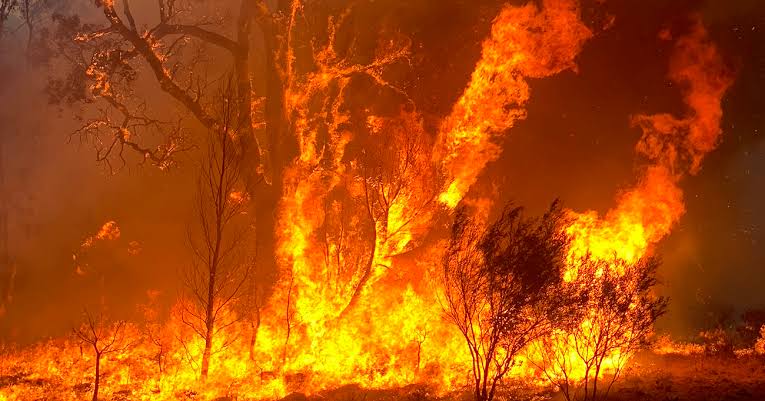
As the dry season sets in across Buluk, the threat of bushfires is once again becoming a major concern for farmers, livestock owners and communities across the area.
The combination of intense heat, dry vegetation and strong winds creates favourable conditions for bushfires, which often spread rapidly across farmlands, grasslands, forest zones and other vegetated areas.
For many communities in Buluk, which comprises the Builsa North Municipality and Builsa South District of the Upper East Region, bushfires have become an annual environmental challenge, leaving behind extensive destruction and economic losses.
The fires destroy important trees, natural vegetation, food crops and habitats for wildlife. They also threaten the livelihoods of farming households whose economic survival depends largely on agriculture and livestock production.
In response to this recurring environmental problem, Voice of Buluk (VOB) is launching a campaign against bushfires to educate and sensitise residents on the dangers of indiscriminate burning and the importance of protecting the environment.
The campaign seeks to mobilise individuals, farmers, traditional authorities, community leaders, youth groups and other stakeholders to take collective responsibility for preventing bushfires and safeguarding the natural resources of Buluk.
Bushfires threaten farmers and food security in Buluk
Agriculture remains a major source of livelihood for many households in Buluk. However, the recurring incidence of bushfires poses a serious threat to agricultural production and household incomes.
When fires spread into farmlands, farmers risk losing their crops, stored agricultural produce and investments made throughout the farming season.
For smallholder farmers who depend on seasonal harvests to feed their families, generate income and finance subsequent farming activities, a single bushfire incident can result in significant financial hardship.
Beyond the immediate destruction of crops, bushfires can also damage soil structure, reduce organic matter and affect the long-term productivity of agricultural land.
The consequences extend beyond crop farmers to livestock owners, whose animals depend on natural vegetation for grazing.
Livestock farmers also bear the cost
The destruction of vegetation by bushfires creates additional difficulties for livestock farmers across Buluk.
As grasslands and other natural feeding areas are consumed by fire, cattle, sheep and goats are left with fewer sources of natural feed.
This can result in inadequate nutrition, weight loss, reduced productivity and, in severe cases, the death of livestock.
For livestock farmers who have invested substantial resources in raising their animals, these losses can wipe out years of investment and undermine their economic stability.
The destruction of grazing areas may also increase the cost of livestock production as farmers are forced to seek alternative sources of animal feed.
Environmental consequences go beyond the dry season
The impact of bushfires is not limited to the immediate destruction visible after an outbreak.
Repeated burning can gradually degrade the environment, destroy valuable indigenous tree species, affect wildlife habitats and reduce biodiversity.
The loss of vegetation also exposes the soil to erosion, particularly when heavy rains begin. This can contribute to land degradation and undermine the ability of the soil to support agricultural production.
Furthermore, smoke from bushfires contributes to air pollution, creating health risks for people, particularly children, older persons and individuals with respiratory conditions.
The destruction of trees and vegetation also affects the environment’s ability to absorb carbon dioxide, further contributing to climate change.
Protecting Buluk’s vegetation, therefore, is not simply an environmental responsibility; it is also an investment in agriculture, public health, livelihoods and the future of communities.
Voice of Buluk launches campaign to combat bushfires
Recognising the far-reaching consequences of bushfires, Voice of Buluk is initiating a public education and sensitisation campaign aimed at changing attitudes and encouraging responsible environmental practices.
The campaign will focus on educating residents about the causes and dangers of bushfires, the economic consequences for farming households and the collective responsibility of communities in preventing outbreaks.
Through public awareness content, community engagement and educational messages, Voice of Buluk seeks to encourage residents to adopt safer practices and become active participants in protecting the environment.
The campaign will also highlight the importance of responsible land preparation, controlled burning where legally permitted, and the establishment of firebreaks to prevent fires from spreading.
It will encourage farmers and community members to avoid indiscriminate burning of grasslands and vegetation, particularly during periods of extreme dryness and strong winds.
Voice of Buluk also calls on traditional authorities, assembly members, the Ghana National Fire Service, the National Disaster Management Organisation (NADMO), agricultural extension officers, environmental organisations and other relevant institutions to support community-level efforts to prevent and respond to bushfires.
Practical steps residents can take to prevent bushfires
Preventing bushfires requires collective action and responsible behaviour. Residents across Buluk are encouraged to observe the following precautions:
1. Avoid indiscriminate burning: Do not set fire to grasslands, bushes or farms without taking appropriate precautions and complying with applicable fire regulations.
2. Create firebreaks: Farmers and landowners should establish and maintain firebreaks around farms, plantations, homes and other vulnerable properties.
3. Extinguish fires completely: Ensure that cooking fires, charcoal-burning sites and other open flames are properly extinguished before leaving them unattended.
4. Avoid careless disposal of burning materials: Cigarette ends, matches and other sources of ignition should never be carelessly discarded in dry vegetation.
5. Report outbreaks immediately: Residents should alert the Ghana National Fire Service and local authorities whenever they notice an uncontrolled fire.
6. Protect young trees and vegetation: Communities should discourage unnecessary burning, especially in areas with valuable trees, plantations and natural vegetation.
7. Support community fire volunteers: Community members should work with relevant authorities to strengthen local fire prevention, early warning and response efforts.
Protecting Buluk is a shared responsibility
The fight against bushfires cannot be left to the Ghana National Fire Service or government institutions alone. It requires the active participation of everyone, from farmers and livestock owners to traditional leaders, young people and ordinary residents.
Every avoidable fire prevented represents crops saved, trees protected, livestock preserved and livelihoods secured.
Voice of Buluk believes that protecting the environment today is essential to securing the future of generations yet unborn.
Through this campaign, the organisation is calling on residents of Builsa North and Builsa South to make bushfire prevention a shared community responsibility.
Let us protect our farms. Let us protect our trees. Let us protect our vegetation. Let us protect Buluk.
The time to act is now, before another dry season leaves communities counting their losses.