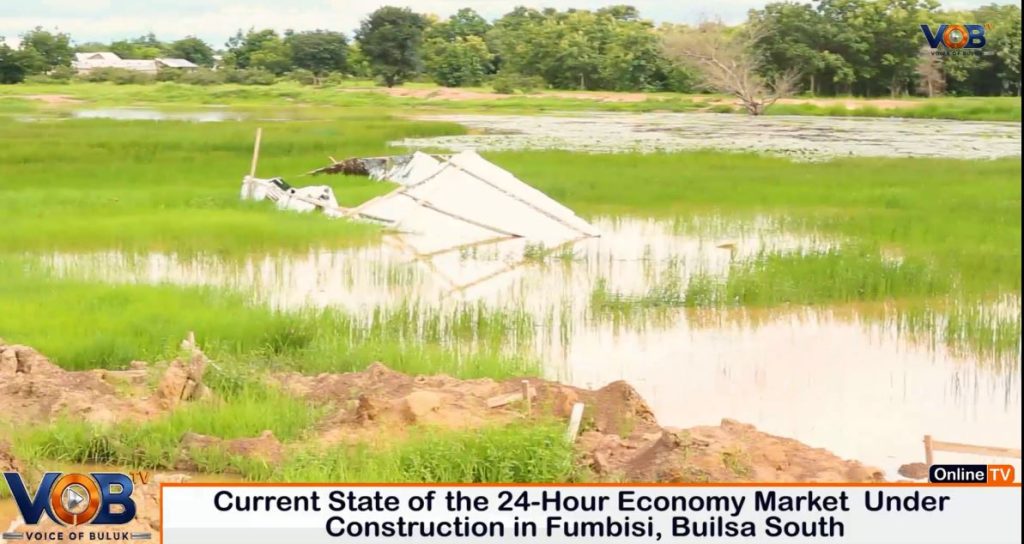
The much-anticipated 24-Hour Economy Market project at Fumbisi in the Builsa South District of Ghana’s Upper East Region has come under scrutiny after the construction site was inundated with rainwater, forcing work to reportedly grind to a halt.
The development has triggered concern among some residents, who are questioning whether the selected location is suitable for a major market facility, particularly during the rainy season.
The project was officially launched in May 2026 when the Member of Parliament for Builsa South, Dr. Clement Abas Apaak, joined chiefs and residents to cut the sod for the construction of what was described as a modern 24-Hour Economy Market.
At the time, Dr. Apaak described the project as an important intervention that could transform economic activity, create employment and improve livelihoods in the constituency. The project forms part of the government’s broader 24-hour economy agenda.
However, only weeks after the sod-cutting ceremony, questions are emerging about the project’s progress and the suitability of the construction site.
Construction site submerged in rainwater
During a visit to the project site this week, a team from Voice of Buluk observed that the area earmarked for the market had been heavily flooded following rainfall.
Water had accumulated across significant portions of the site, including the foundations already excavated for the proposed facility.
The flooding has effectively transformed parts of the construction area into pools of stagnant rainwater, making construction activities difficult.
The metal sheets initially erected to cordon off the construction area were also observed to have been blown away by strong winds, leaving sections of the site exposed.
According to observations at the site, construction activities were not ongoing at the time of the visit.
Residents question the choice of location
The flooding has intensified concerns among some residents about the suitability of the location selected for the market.
One resident living close to the project site told the news team that the area is a known pathway through which rainwater flows during the rainy season.
According to the resident, the flooding is therefore not an entirely new phenomenon but a recurring feature of the area during periods of heavy rainfall.
Residents are consequently asking whether adequate drainage and hydrological considerations were taken into account before the site was selected and construction commenced.
Their concerns are centred on a fundamental question: Can a major public market be sustainably constructed on a site that is regularly affected by floodwater?
Proximity to ‘Akinkang Moi’ dam raises further concerns
Another issue attracting attention is the project’s proximity to a local dam popularly known as “Akinkang Moi.” The dam reportedly collects substantial amounts of rainwater during the rainy season.
During its visit, the Voice of Buluk team observed that the foundations excavated for the market were located close to the bank of the dam.
This has raised questions about how the completed facility would be protected from water accumulation, flooding and possible erosion, particularly during periods of intense rainfall.
For a project expected to operate as a major economic centre, residents say the long-term implications of the site’s drainage characteristics need to be properly addressed.
Is Fumbisi facing another abandoned project?
The current situation has revived a familiar fear among some residents: that the project could eventually become another abandoned development in Buluk.
At this stage, there is no evidence that the project has officially been cancelled or permanently abandoned. However, the apparent stoppage of work amid flooding has raised concerns about whether construction can resume without significant intervention.
Residents want the relevant authorities and project managers to explain how the contractor intends to deal with the water currently occupying the site.
They also want clarification on whether the original site assessment adequately considered the area’s natural water flow and its proximity to the dam.
What happens when the rains intensify?
The questions become even more important as the rainy season progresses.
If the excavated foundations are repeatedly submerged, engineers may have to determine whether the accumulated water could affect the integrity of the foundation works or require additional drainage and water-control measures.
Similarly, if the site lies along a natural water pathway, simply pumping out water may not provide a permanent solution.
A sustainable solution could require a comprehensive assessment of the site’s drainage patterns, appropriate storm-water channels, elevation levels, foundation design and measures to protect the facility from runoff.
These are technical matters that would ultimately require assessment and direction from qualified engineers and the relevant authorities.
Residents demand answers
For residents, the issue is bigger than the current flooding.
They want to know why the location was selected, whether a proper site and drainage assessment was undertaken before construction began, and what measures are being considered to ensure that the project survives the rainy seasons.
Among the questions now being asked are:
- Why was this particular location selected for the 24-Hour Economy Market?
- Was the area’s seasonal water flow properly assessed before construction?
- What measures have been incorporated into the design to manage storm water?
- How will the project deal with the proximity of the Akinkang Moi dam?
- Can the existing foundation design withstand the site’s water conditions?
- When will construction resume?
- Who is responsible for addressing the flooding before construction continues?
- And most importantly, will the Fumbisi 24-Hour Economy Market be completed and delivered to the people of Builsa South?
A project residents want to succeed
Despite the concerns, the development of a modern market remains a welcome prospect for many people in Fumbisi and the wider Builsa South District.
When the sod was cut in May, the project was presented as an opportunity to expand economic activity, create jobs and improve livelihoods in the district.
The challenge now is to ensure that those ambitions are not undermined by avoidable problems at the construction site.
The flooding at the Fumbisi site should therefore prompt urgent attention from the project managers, the Builsa South District Assembly, engineers and other relevant authorities.
Before construction proceeds further, residents deserve clear answers on the site’s drainage conditions and the engineering measures required to make the project viable.
For now, the waterlogged foundations at the proposed market site stand as a visible reminder that the success of a major development project begins long before the first block is laid; with choosing the right site, understanding the environment and planning for the realities of the location.
The people of Builsa South will be watching closely to see whether the Fumbisi 24-Hour Economy Market becomes the transformative project promised at its sod-cutting ceremony, or another unfinished structure left behind by the rains.