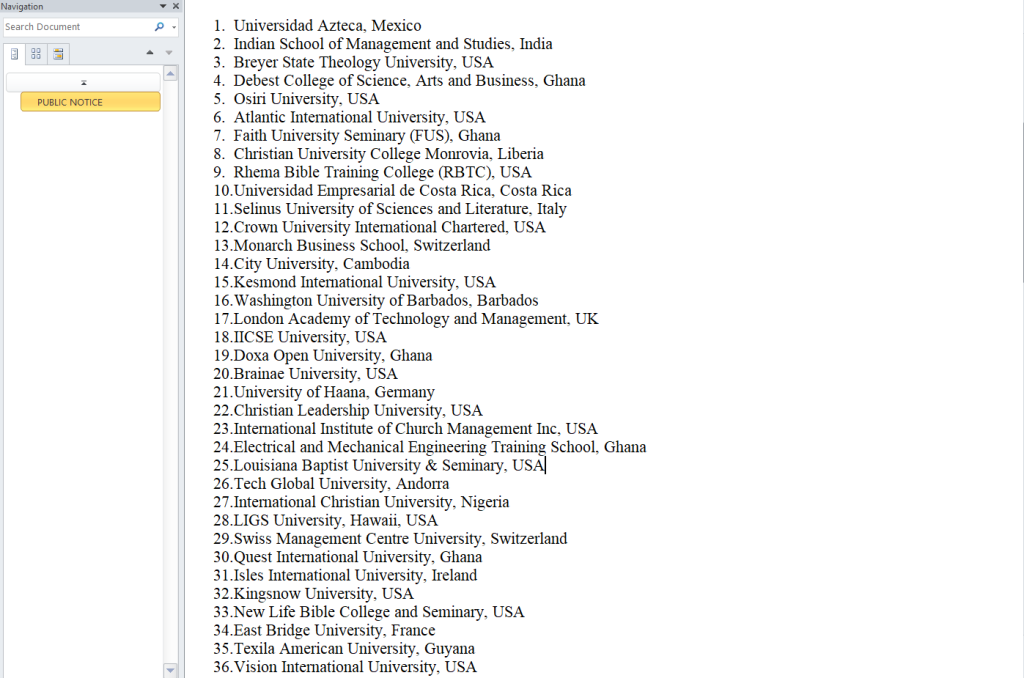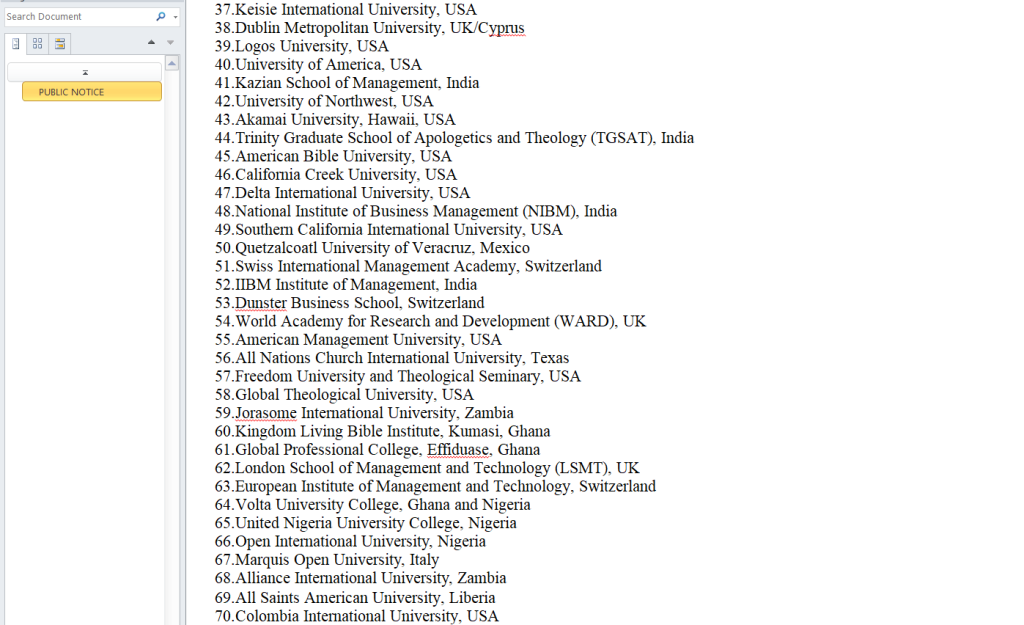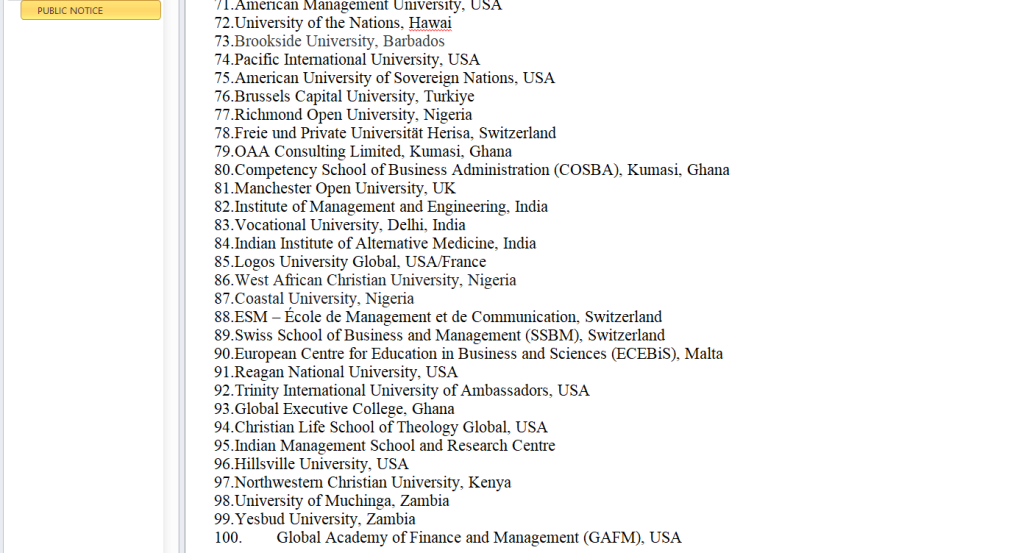
The Ghana Tertiary Education Commission (GTEC) has released an updated list of 100 tertiary institutions it does not currently recognise, urging students, parents, employers and the general public to exercise caution when dealing with qualifications issued by the institutions.
The Commission’s latest warning forms part of its efforts to protect the public from institutions whose programmes or academic awards do not meet the required regulatory and quality assurance standards.
In a public notice dated August 28, 2026, GTEC advised prospective students and other stakeholders to conduct proper checks on the recognition status of tertiary institutions before enrolling in their programmes or accepting certificates issued by them.
GTEC warns against unrecognised certificates
According to GTEC, the institutions on the latest list are currently not recognised by the Commission. The institutions include both local and foreign entities operating across different areas of tertiary education.
The Commission has therefore cautioned the public to pay particular attention to the status of academic institutions before committing money or relying on qualifications they issue.
The warning is particularly important for students seeking university admission, professionals using academic certificates for employment or licensing, and employers assessing qualifications presented by job applicants.
GTEC’s latest publication follows previous warnings issued during 2026 concerning tertiary institutions whose qualifications were not recognised in Ghana. Earlier in the year, the Commission had also published lists containing dozens of institutions with recognition and accreditation concerns.
Students urged to verify institutions before enrolling
GTEC is encouraging prospective students and parents to make accreditation and recognition checks an essential part of the admission process.
Students who are attracted by programmes advertised online, particularly those offering foreign qualifications or distance-learning opportunities, are advised not to rely solely on promotional materials from institutions.
Instead, prospective students should independently verify whether an institution and its programme have the necessary recognition before paying fees or beginning their studies.
This is important because an academic qualification obtained from an institution that is not recognised may create difficulties when the holder seeks further education, employment, professional licensing or other official recognition.
Employers also cautioned
The GTEC warning extends beyond students and parents.
Employers, professional bodies and other organisations that assess academic qualifications have also been urged to exercise due diligence when reviewing certificates presented by individuals.
The Commission’s position means that organisations should not automatically assume that a certificate is valid simply because it carries the name of a university, college or other tertiary institution.
Verification of the institution and qualification can help prevent individuals and organisations from relying on credentials that may not have the required recognition.
GTEC list includes local and foreign institutions
The 100 institutions identified by GTEC include institutions associated with Ghana as well as institutions based in other countries.
Previous GTEC notices have covered institutions from countries including the United States, United Kingdom, Switzerland, India, Mexico, Nigeria, Liberia, Zambia, Italy, Germany and other jurisdictions.
The Commission’s concerns are not limited to traditional universities. Previous notices have included institutions operating as business schools, management institutions, theological seminaries, professional training establishments and distance-learning providers.
Why GTEC’s warning matters
The recognition of a tertiary institution is an important consideration for anyone investing time and money in higher education.
For students, enrolling in an unrecognised institution can potentially result in significant financial losses and difficulties when attempting to use a qualification for employment or further studies.
The issue is also increasingly relevant as online education and cross-border programmes become more accessible. Institutions can market degree and certificate programmes to students in Ghana even when their qualifications may not have the recognition required within Ghana’s tertiary education system.
GTEC’s latest notice is therefore a reminder that students should verify accreditation and recognition before making an admission decision.
What students should do before enrolling
Prospective students should consider the following steps before enrolling in any tertiary institution:
- Verify whether the institution is recognised by GTEC.
- Confirm that the specific programme being offered has the necessary approval or accreditation.
- Do not rely solely on social media advertisements or claims made by agents.
- Ask questions about the validity of certificates for employment and further education in Ghana.
- Seek clarification from the relevant regulatory authorities when the status of an institution is unclear.
The latest development reinforces the need for prospective students to conduct thorough research before choosing where to pursue tertiary education.
GTEC’s warning also highlights the responsibility of students, parents, employers and institutions to ensure that academic qualifications being pursued or presented are properly recognised.
As Ghana continues to expand access to tertiary education, verifying the legitimacy of institutions and programmes remains critical to protecting students and maintaining confidence in the country’s higher education system.